BoundedVec sizes vs. proving time in Noir
During our work on Noir we ran extensive benchmarks to understand how the compiler and the proving system behave. We were pleasantly surprised by the maturity and speed of Noir throughout all our tests. We did find some rough edges, but the community was quick to help us smooth them out. Having worked with it, we believe that Noir is a solid foundation for ZKPs in electronic identities as well.
In addition to our main
ZKP Proof of Concepts
repository, we ran
extensive experiments
to better understand how to use Noir effectively.
One of these benchmarks tested the proving time as a function of
BoundedVec input sizes, and you can find it here:
noir-benchmarks.
Noir supports BoundedVec as an input type.
This behaves similarly to a variable-length string, but only up
to a maximum size.
For a ZKP circuit, it is necessary to know the maximum size beforehand;
otherwise the circuit has to be re-created from scratch.
So even if the input does not reach the maximum length, the circuit
itself is compiled for that full size.
We measured the time it took to create a proof as we varied the
BoundedVec maximum size while keeping the actual input size fixed:
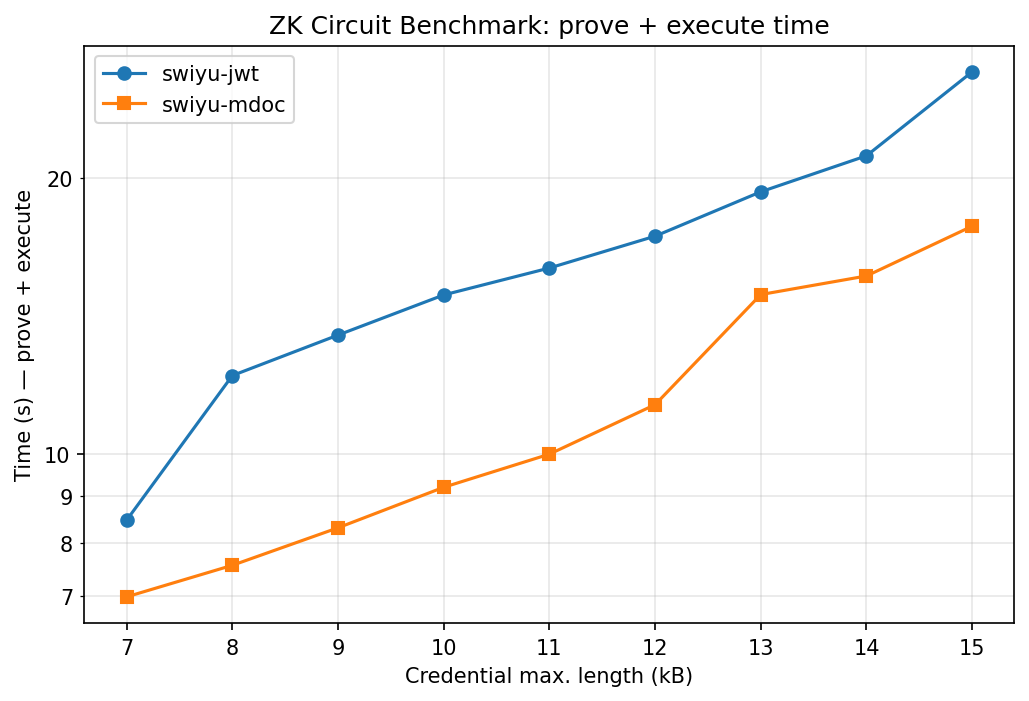
On the y-axis you can see the time it took to create a full proof, which includes:
- Execution: filling out the private and public values in the compiled circuit. This is something the holder needs to do for every new proof.
- Proving: generating a mathematical proof that the values in the circuit satisfy all the constraints defined by the Noir program.
The key insight from this benchmark is that the BoundedVec maximum
size should be set as close to the actual input size as possible.
If the BoundedVec maximum is set too large, the prover will
simply waste cycles proving unused capacity!